Nigeria has successfully found an administrative “home” and a 10-year master plan for its massive marine wealth, but the country must now aggressively transition from paperwork to practical profits for its citizens.
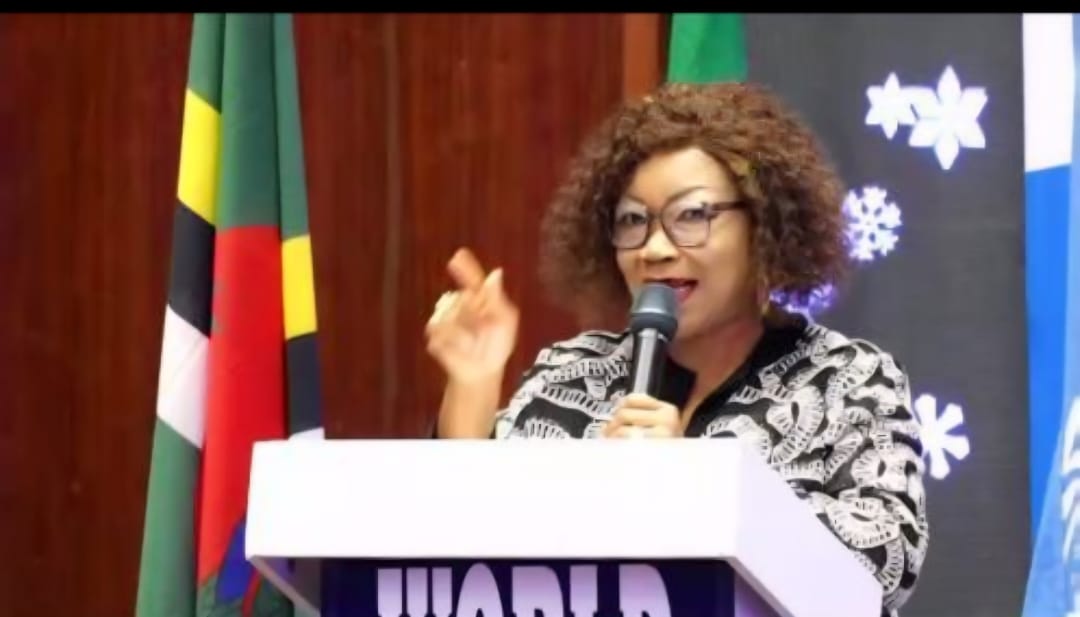
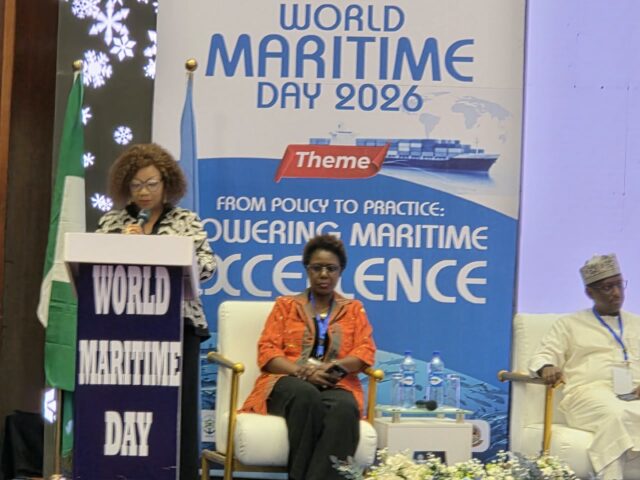
This was the central message delivered on Friday, 16 October 2026, by Mrs. Mfon Ekong Usoro, FCILT, Managing Partner at Paul Usoro & Co., during a powerful keynote address commemorating World Maritime Day 2026.
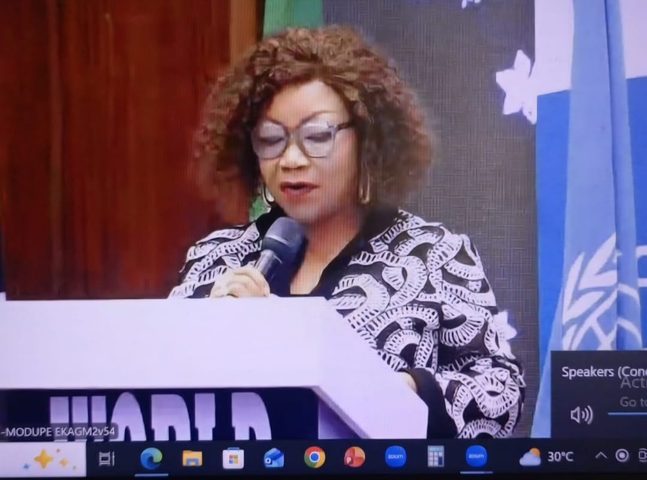
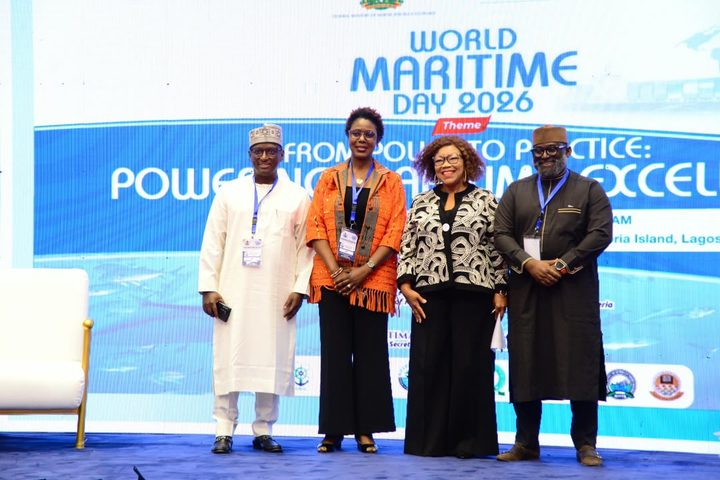
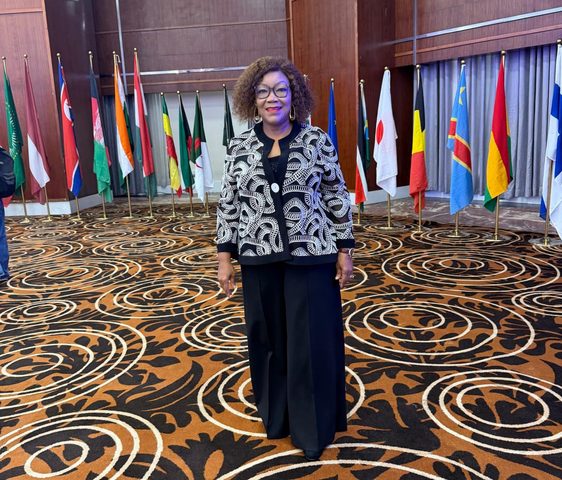
Speaking at the prestigious Oriental Hotel in Victoria Island, Lagos, the prominent maritime law expert—who brings monumental authority as the pioneer Director-General of the Nigerian Maritime Administration and Safety Agency (NIMASA) and the immediate past President of the Chartered Institute of Logistics and Transport (CILT Nigeria)—served as both the event’s Chairperson and Keynote Speaker.
The high-profile event drew an elite gathering of maritime leaders, headlined by the Honourable Minister of Marine and Blue Economy, His Excellency, Adegboyega Oyetola, CON. Accompanied by the Ministry’s Permanent Secretary, Hajiya Sugra Mahmoud, alongside key directors and the Chief Executive Officers of all maritime parastatals, the administration underscored its unified commitment to sector reforms. Legislative support was equally formidable, marked by the prominent attendance of the Senate Committee Chairman and his counterpart from the House of Representatives.
Addressing this influential audience of policymakers and industry heavyweights, Usoro lauded the International Maritime Organization (IMO) for pivoting toward execution under its 2026 theme, “From Policy to Practice: Powering Maritime Excellence.”
However, she boldly challenged Nigeria to look past mere bureaucratic milestones, urging leaders to focus strictly on delivering tangible, measurable economic relief to struggling businesses and coastal communities.
Nigeria’s journey to harnessing its aquatic resources has moved at a structured pace over the last three years:
• 2023: The foundational milestone was achieved with the creation of the dedicated Ministry of Marine and Blue Economy by the President.
• 2025: The Federal Executive Council approved and launched a comprehensive National Blue Economy Policy with a 10-year implementation horizon.
• 2026: Nigeria officially entered the critical delivery phase.
Usoro emphasized that Nigeria’s policy uniquely localizes the “Blue Economy” to mean far more than just ocean trade. It stretches from the Atlantic coastline deep into the hinterlands—encompassing rivers, lakes, wetlands, and deltas across all 36 states.
Usoro also explained that the policy spans five explosive growth sectors:
Maritime Trade, Fisheries, Marine Resources, Energy Sustainability, and Blue Tourism.
The critical question hanging over the festivities, according to Usoro, is performance tracking:
Are these big ideas actually translating into jobs and wealth, and can stakeholders see the data?
To bridge the gap between policy and reality, Mfon Usoro boldly proposed the immediate establishment of an Integrated Blue Economy Ecosystem Framework.
She warned that the current governance structure leaves too much ambiguity around private sector inclusion and the exact composition of the vital Policy Advisory Council.
“An effective Blue Economy governance framework cannot operate in a silo,” Usoro argued.
“It requires a multi-ministerial coordinating body explicitly named in the policy document to drive joint ownership and seamless execution.”
She insisted that for the council to succeed under the Minister of Marine and Blue Economy, it must officially include the Federal Ministers of Transport, Finance, Petroleum Resources, Environment, Budget, Defence, Solid Minerals, Science & Technology, Education, and Agriculture, alongside the Central Bank Governor, commercial bank executives, and state commissioners.
Why Silos are Killing Indigenous Shipping Usoro pointed to a glaring historical bottleneck: the long-stalled implementation of Sections 36 and 37 of the NIMASA Act. On paper, these statutory mandates are designed to aggressively grow local shipping capacity.
They guarantee qualified indigenous shipping companies exclusive rights to carry 100% of government-generated cargo, at least 50% of bulk dry and liquid cargo, and 50% of international aid cargo. They also mandate an efficient strategy to ensure Nigerian-flagged vessels carry the nation’s crude oil exports.
“The truth be told, neither NIMASA nor the Ministry of Marine and Blue Economy can fulfill this mandate alone,” Usoro stated bluntly.
She noted that unlocking this massive indigenous shipping boom requires a synchronized, institutionalized ecosystem. It demands that revenue agencies, security forces (like the Nigerian Navy and Customs), financial regulators, and cargo-generating MDAs sit at the exact same table to synchronize trade terms, tax incentives, and maritime security.
To solve this, she called for immediate internal cohesion between maritime agencies. “NIMASA cannot treat inefficient port logistics as solely the Nigerian Ports Authority’s (NPA) responsibility, just as NPA cannot treat the growth of nationally owned tonnage as solely NIMASA’s responsibility,” she warned.
Usoro did not mince words when addressing Nigeria’s international standing. “What is Nigeria’s position on port logistics performance indicators and the liner shipping connectivity index? Available statistics indicate that we are not doing well,” she revealed.
She explained that a nation’s port logistics score and reputational risk directly dictate how attractive its ship registry is to global shipowners. While there has been a rise in Nigerian-flagged cabotage vessels, Usoro clarified that this is driven by mandatory legal provisions rather than shipowners’ free, commercial decisions.
The Verdict: A “Whole-of-Government” Imperative The root challenge, Usoro observed, is that Nigeria’s Blue Economy aspirations are not yet treated as a shared national goal. External Ministries, Departments, and Agencies (MDAs) have failed to adopt targets like Nigerian tonnage growth or high port logistics scores as their own priorities,
changes require administrative shifts.
Usoro commended NIMASA for returning to its core UNCLOS-backed mandate as a flag State administration, praising its recent push toward building a competitive, competent ship registry. She added that a highly professionalized Ministry, staffed with well-skilled personnel in the right roles, remains a non-negotiable requirement.
Concluding her address with a rallying cry, Usoro called for a sweeping, “Whole-of-Government” approach that assigns shared responsibilities, coordinates implementation, and aggressively tracks measurable results.
Only then, she noted, can robust policies translate into environmental sustainability, business growth, and improved livelihoods for every Nigerian.