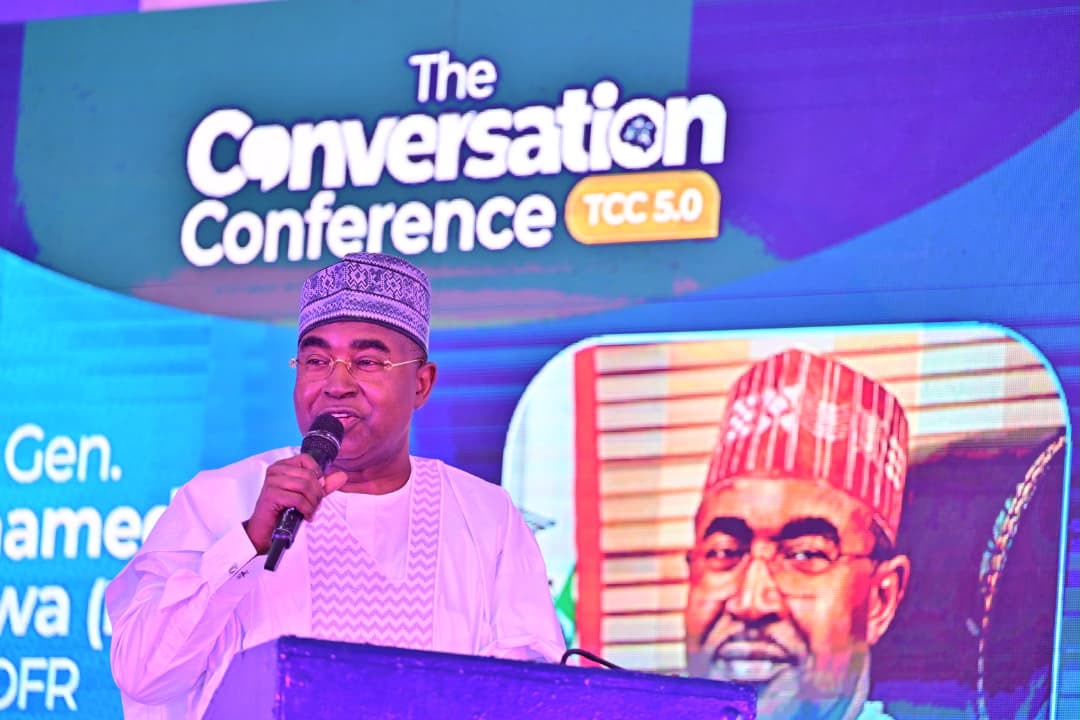
The Chairman and Chief Executive Officer of the National Drug Law Enforcement Agency (NDLEA), Brig. Gen. Mohamed Buba Marwa (Rtd), has warned of a vicious, reinforcing cycle between substance abuse and psychological distress, stating that “drug use and mental illness feed each other.” Calling for a paradigm shift in how the nation tackles addiction, Marwa cautioned: “If we only arrest the symptoms, we will keep missing the cause.”
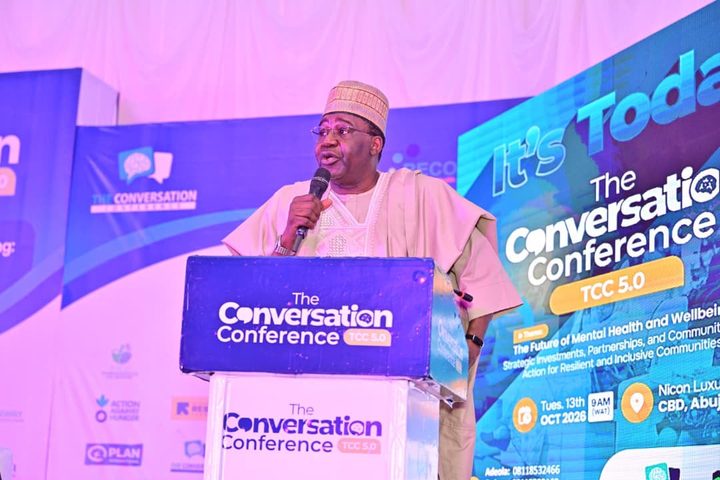
The NDLEA boss made the remarks on Tuesday, October 13, 2026, while presiding as Chairman of the 5th edition of The Conversation Conference (TCC 5.0). The high-level mental health summit, held at the Nicon Luxury Hotel in Abuja, was organised by the Intersect Consortium under the leadership of UK-based Consultant Psychiatrist, Dr Vincent Udenze.
In a press release detailing the event, NDLEA Director of Media and Advocacy, Femi Babafemi, noted that Marwa—who previously chaired both the debut edition in 2022 and the subsequent third edition—applauded the platform’s rapid evolution.
He observed that the conference has matured into one of Nigeria’s most prominent mental health assemblies, emphasizing that convening right on the heels of World Mental Health Day offers a vital opportunity to transition from mere awareness to concrete action.
Central to his address was the hidden catalyst behind substance abuse, with Marwa revealing that untreated internal pain is the true anchor for many patients currently undergoing rehabilitation across NDLEA facilities.
Reflecting on the systemic failures that aggravate the crisis, Marwa stated:
“For too long, we treated mental health as a private burden, hidden behind shame and silence.

“In my work at the NDLEA, I see the cost of that silence daily. Behind many cases of drug abuse is untreated pain: depression nobody noticed, trauma nobody addressed, a young person who found a substance before finding help.
“Drug use and mental illness feed each other. If we only arrest the symptoms, we will keep missing the cause.”
Addressing the conference theme of strategic investments, partnerships, and community-led action, Marwa asserted that mental wellbeing cannot thrive where hopelessness and poverty drive people into harm. To demonstrate this, he cited the agency’s success in three pilot communities in Ondo State, where families previously trapped in illicit cannabis cultivation were successfully transitioned into lawful livelihoods.
The NDLEA boss revealed plans to scale this economic empowerment framework nationwide, extended an open invitation to strategic partners, and noted:
“Your theme speaks of strategic investments, partnerships and community-led action. At the NDLEA, these are not abstract ideas. They are things we have done.
“In three pilot communities in Ondo State, we worked with the people themselves to build legitimate livelihoods, so that families who once depended on illicit cultivation could earn a dignified, lawful income.

“When people have hope, income and a stake in their future, stress eases, families stabilise and communities grow resilient. These were solutions designed with communities, not imposed on them.
“We intend to scale this model across the country and invite our partners to walk that road with us.”
Marwa also highlighted the agency’s War Against Drug Abuse (WADA) campaign, which actively targets youth in schools and local communities. He praised the NDLEA’s 24/7 toll-free helpline, describing it as an essential lifeline ensuring that “a frightened teenager, a worried mother or a person on the edge can be heard in the dead of night, at no cost.”
Delving into the agency’s clinical impact, Marwa disclosed that over 53,843 individuals have passed through the NDLEA’s 31 rehabilitation facilities across Nigeria in the last five years.
“Behind that number are fathers returned to their families and young people returned to school and work,” he remarked.
Turning his focus to systemic funding, the NDLEA Chief insisted that mental health “cannot remain the poorest relation in our health budgets.” He argued that every naira invested in prevention, personnel, and accessible treatment directly yields safer communities and stronger families.
Marwa demanded a significant increase in the workforce—including psychiatrists, psychologists, and counselors—while advocating for the integration of mental health into primary healthcare so that “no one travels hundreds of kilometres to be heard.”
Furthermore, he stressed that financing must be equitable because “care that only the well-off can afford is not a system, it is a privilege.”
Commending the conference’s specific spotlight on women and children, Marwa noted that survivors of violence, displaced mothers, vulnerable girls, and persons living with disabilities are too easily overlooked by conventional systems. NDLEA data, he explained, proves that addiction recovery lasts much longer when the mother, the child, and the household are supported as a single unit.
Because no single institution can carry this socio-economic burden alone, Marwa called for deep, inter-sectoral collaboration across health, education, security, justice, and social welfare ministries.
He closed by thanking Vice President Kashim Shettima—who was represented as the Special Guest of Honour by Senator Ibrahim Hassan Hadejia—stating that the Presidency’s involvement firmly signals that mental health has become a top national priority.
Urging delegates to leave the summit with actionable commitments, Marwa charged:
“Finance what works, scale proven community models, put women, children and the vulnerable first, and hold one another accountable for results. Let us build a Nigeria where seeking help is an act of courage, where recovery is possible, and where no one suffers alone.”