
The Federal Government has renewed its pledge to supercharge Nigeria’s domestic maritime capacity, promising indigenous shipowners full backing and the swift disbursement of the long-awaited Cabotage Vessel Financing Fund (CVFF).
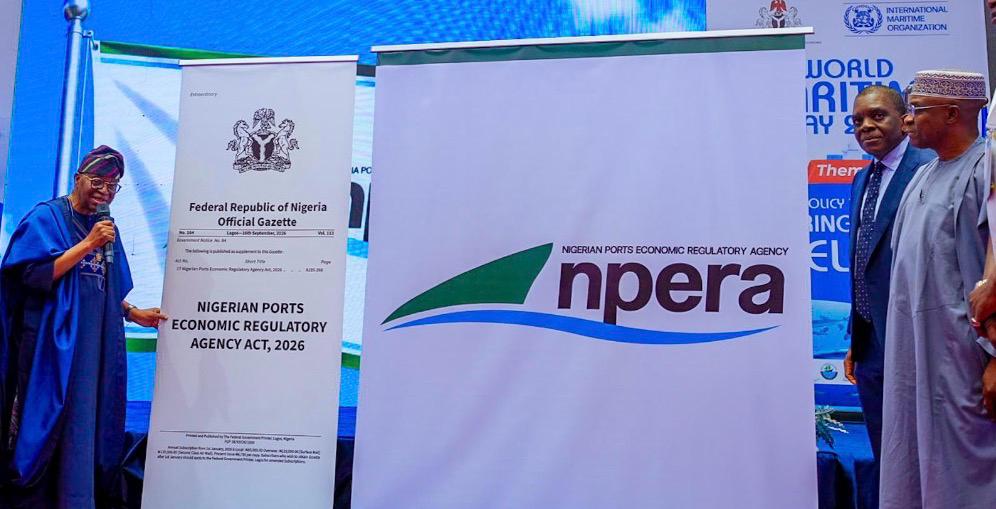
The Minister of Marine and Blue Economy, Dr Adegboyega Oyetola, dropped the anchor on these commitments on Friday, October 16, 2026, during the ministry’s Third Quarter Citizens’ and Stakeholders’ Engagement in Victoria Island, Lagos.

In a statement released by his Special Assistant, Dr Bolaji Akinola, the Minister emphasized that the administration is unwavering in its enforcement of the Coastal and Inland Shipping (Cabotage) Act. The goal is clear: ensure Nigerian operators completely own and drive domestic maritime trade.
“To our indigenous shipowners, I wish to reaffirm this Administration’s commitment to the development of indigenous shipping capacity and the effective implementation of the Coastal and Inland Shipping (Cabotage) Act,” Oyetola declared.
To dismantle the financing bottlenecks holding local operators back, Minister Oyetola revealed he has ordered the Nigerian Maritime Administration and Safety Agency (NIMASA) to coordinate with approved Primary Lending Institutions (PLIs) to speed up CVFF processing for qualified applicants.
Acknowledging the industry’s anticipation, Oyetola noted, “Progress may require patience, but our direction remains firm.”
The CVFF is widely seen as the ultimate catalyst to expand Nigeria’s national fleet. However, Oyetola pointed out that the economic ripple effects will stretch far beyond just buying ships. The fund is designed to stimulate investment across the entire maritime value chain, including:
- Shipbuilding and marine engineering
- Vessel maintenance and repairs
- Comprehensive maritime logistics
“The effective deployment of the CVFF has the potential to strengthen our indigenous fleet and stimulate investment across the maritime value chain,” the Minister added.
Beyond funding, the Minister underscored that building a fierce, globally competitive domestic industry requires aggressive investments in professional training, local expertise, and robust support for homegrown businesses.
“Our ultimate objective is to build an industry in which Nigerians possess the opportunities, capabilities and resources to own, operate and lead,” Oyetola concluded.
The high-level engagement also featured international insights, with the Ambassador of the Kingdom of Denmark to Nigeria, Jens Ole Bach Hansen, delivering a presentation on Denmark’s sustainable blue economy to offer a blueprint for strategic partnerships, investments, and technology transfer