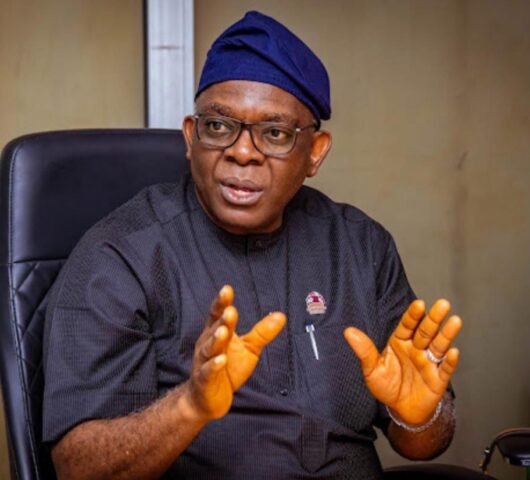
By: Dr. Philip B. Olusola,
Lead City University, Ibadan
There is something profoundly disturbing about the frequency with which Nigerian markets are going up in flames. Hardly does the smoke from one devastating inferno disappear before another is reported, leaving behind charred shops, destroyed merchandise, shattered businesses, and devastated families.
Even as this article is being written, another painful reminder has emerged from Ibadan. On Saturday, August 29, 2026, a fire incident was reported at Araromi Market in the Onipasan area of Ibadan North-East Local Government Area, destroying shops and goods. This came barely days after a major fire at Oranyan Market, also in Ibadan North-East, reportedly destroyed hundreds of shops.
For the affected traders, these are not merely statistics. They represent years of savings, investments, and aspirations going up in smoke. For families whose livelihoods depend entirely on these businesses, a single night of fire can plunge them into uncertainty and hardship.
Then, the familiar cycle begins expressions of sympathy, visits by government officials, promises of assistance, investigations, and eventually, silence until another market burns.
How long shall we continue this cycle?
The recurring outbreak of fires in Nigerian markets can no longer be dismissed as a collection of unfortunate accidents. It has become a serious public safety, governance, and economic problem requiring urgent and coordinated intervention.
The Federal Fire Service reported 190 fires in markets and trading centres in 2025, with 39 deaths and property losses estimated at N22.27 billion. It also identified electrical-related problems, including power surges, overloads, and wiring faults, as the leading causes of fire incidents generally during the year.
The figures should concern every Nigerian. Markets are not simply places of commerce. They are major engines of the informal economy, providing employment and sustaining millions of households. When a major market burns, the consequences spread beyond immediate victims to employees, suppliers, transporters, creditors, consumers, and entire communities.
A Recurring Disaster That Should Not Be Inevitable
After every fire, attention understandably turns to its immediate cause – an electrical fault, generator, gas cylinder, fuel, suspected arson, or human negligence. Identifying the cause is important, but it does not explain why relatively small fires are sometimes allowed to become catastrophic.
Many Nigerian markets have expanded far beyond their original designs. Walkways become shops; open spaces are occupied; buildings are altered without adequate safety considerations; combustible materials are stored indiscriminately; and emergency access routes are obstructed by shops, extensions, and vehicles.
Consequently, when fire breaks out, firefighters may struggle to reach the affected area. A manageable incident can, therefore, become an inferno.
This is where the issue moves beyond individual negligence to questions of planning, regulation, and enforcement.
Prevention Must Replace Reaction:
Nigeria must fundamentally change its approach to market fires. We cannot continue to concentrate on fighting fires after they have started while giving insufficient attention to preventing them.
Every major market should undergo regular fire-risk assessments covering electrical installations, generators, fuel and gas storage, fire extinguishers, hydrants, emergency exits, water supply, access roads, and combustible materials. Serious violations should attract mandatory corrective action, not another warning.
Modern technology should also be deployed. Major markets should progressively adopt smoke and heat detectors, fire alarms, emergency lighting, and other appropriate early-warning systems. A fire detected in its infancy is much easier to contain than one discovered after it has spread through several shops.
Market associations must equally accept responsibility. A reasonable and transparently managed portion of market levies should support fire-prevention infrastructure, maintenance of emergency routes, firefighting equipment, safety education, and regular drills. Traders should be trained in basic fire prevention and first response, while dangerous electrical connections, blocked passages, and unsafe storage practices must not be tolerated.
Bring the Fire Station Closer:
One practical solution is to bring firefighting facilities physically closer to places where the risks are greatest.
Major commercial markets in Lagos, Onitsha, Aba, Ibadan, Kano, Port Harcourt, Enugu, and other major trading centres should have strategically located, fully functional fire stations or dedicated fire-service posts within or immediately adjacent to them, based on their size, economic importance, population, and risk profile.
This should not be about constructing ceremonial buildings without operational capacity. These market-based fire posts must have functional equipment, adequate water supply, and trained personnel capable of responding immediately while additional units are mobilised from larger stations.
Their role should extend beyond emergency response. Fire personnel stationed near major markets could conduct routine safety inspections, educate traders, organise evacuation drills, and monitor emergency access routes.
Nigeria should seriously consider adopting a simple policy objective:
“A fire station within reach of every major market.”
When a fire starts, professional firefighters should be minutes away – not delayed by distance, traffic congestion, or inaccessible market layouts.
The recent fires in Ibadan should be treated as a warning, not merely another entry in a long list of incidents. What is happening in Ibadan today could happen in Lagos, Onitsha, Aba, Kano, or another major commercial centre tomorrow.
Accountability Must Accompany Prevention:
Every major market fire should be properly investigated. Authorities should establish, as far as possible, the cause of the fire, how it spread, whether safety regulations were violated, whether emergency access was obstructed, how quickly firefighters responded, and whether previous warnings had been ignored.
The purpose of investigation should not be to find a scapegoat. It should be to identify failures and prevent recurrence. Where negligence or deliberate violation of safety requirements is established, appropriate sanctions should follow.
Government assistance to victims is necessary and humane, but compensation must never become a substitute for prevention. It is far better to invest in making a market safe than to spend much more rebuilding it after a disaster.
The insurance industry should also develop affordable market-specific schemes that protect traders against catastrophic loss of stock and business interruption. No trader should be expected to rebuild a lifetime’s investment entirely from personal savings after a single fire.
The Time for Action Is Now:
Nigeria does not lack institutions responsible for fire prevention, emergency response, and regulation. What is often lacking is sustained enforcement, coordination, and accountability.
The country needs a national minimum fire-safety framework for major markets, with regular risk assessments, enforceable standards, functional firefighting infrastructure, and clear responsibilities for government agencies, market associations, traders, and other stakeholders.
The recurring sequence of fire, destruction, tears, government visits, promises, and silence must end.
We need a new sequence: prevention, preparedness, rapid response, investigation, accountability, and continuous improvement.
The real tragedy is not simply that Nigerian markets burn. It is that many of the conditions that make these disasters possible are known in advance. We know the dangers of faulty electrical installations, overcrowding, blocked access routes, inadequate water supply, and poor emergency preparedness.
So, what exactly are we waiting for?
Must another market burn before we act? Must thousands more traders lose their livelihoods before prevention becomes a national priority?
Nigerian markets should be places where people build businesses, create employment, and secure the future of their families – not places where decades of sacrifice can disappear in a single night.
Dr. Philip B. Olusola, PhD.,
Public Affairs Analyst and Academic