
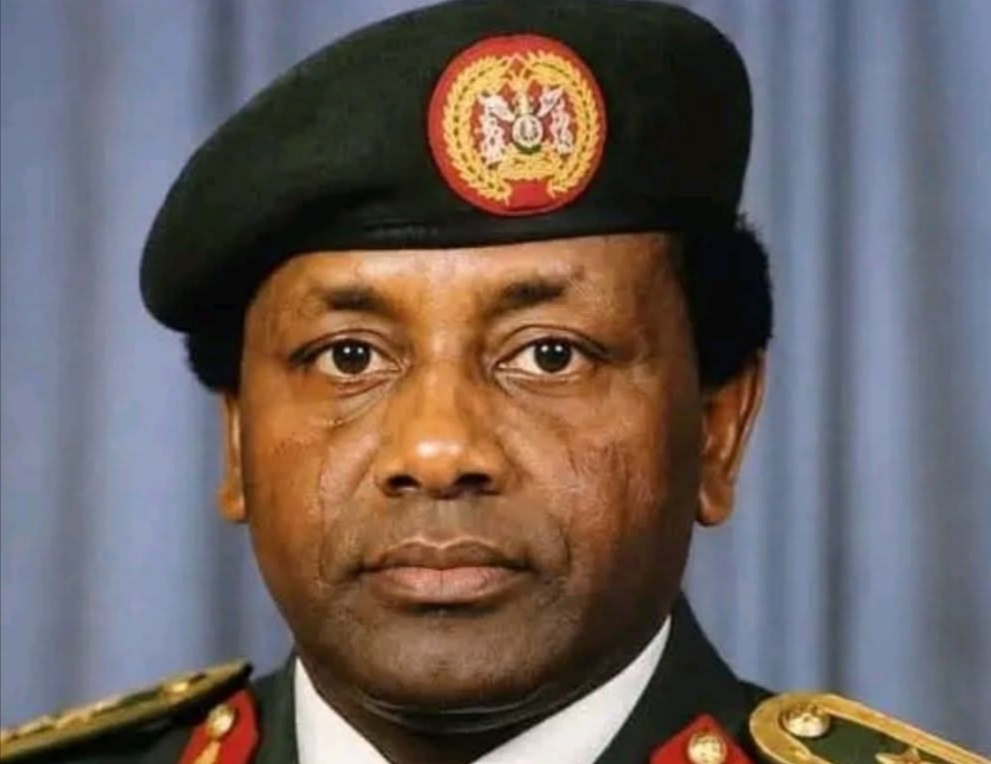
A brewing clash between two top-tier security insiders promises to rewrite the history of Nigeria’s late military ruler, General Sani Abacha. Responding to a provocative account by retired DSS Assistant Director Denis Amachree, Abacha’s former Chief Security Officer, Hamza Al-Mustapha, claims to hold definitive CCTV footage of the ex-Head of State’s final moments.

Al-Mustapha’s counter-narrative directly challenges the retired director’s explosive allegations, which claim that the former military leader died during a late-night romantic encounter. Armed with what he describes as unassailable surveillance evidence, the former security chief’s upcoming disclosure threatens to completely dismantle Amachree’s version of the regime’s final hours.
General Sani Abacha served as Nigeria’s military Head of State from November 1993 until his sudden passing on June 8, 1998.
Speaking to journalists on Saturday, July 25, at Arewa House in Kaduna, Al-Mustapha dismissed the retired operative’s narrative as a scripted fabrication. On the sidelines of the 3rd General Hassan Usman Katsina Memorial Conference, the former security chief urged Nigerians to disregard the book, asserting that he holds definitive CCTV footage of the events.
He emphasized that the publication was merely an attempt to distort history and mislead the public regarding the late Head of State’s final hours.
The sudden backlash follows controversial assertions made by Amachree in his newly released memoir, DSS @ 40: My Journey Behind the Shield. In the book, the retired intelligence operative claims that General Abacha suffered a coitus-induced cardiac arrest inside the presidential villa. Amachree alleges that during an interrogation, a female pharmacist who was with the Head of State at the time explicitly stated, “I did not kill him, he died on top of me.” The memoir explicitly dismisses all alternative conspiracy theories surrounding the June 8, 1998 incident as deliberate acts of deceit.
However, Al-Mustapha fired back, alleging that the author was externalized and manipulated into fabricating the entire account.
“The boy was asked by others to write those lies. I have all the CCTV footage of what happened in my custody, so what he said is not true,” Al-Mustapha asserted.
Al-Mustapha urged the public to disregard the narrative, emphasizing that targeting a deceased leader who can no longer defend himself is fundamentally wrong.
“Just ignore his lies; it is bad to say such things about someone who is dead,” the former security chief stated. “But I want to assure you that the author of the book is acting out a script. He is not acting alone. At the appropriate time, I will respond to these lies. You don’t tell your enemies your plans.”
Amachree’s 348-page memoir positions the high-profile incident inside the Aso Rock Presidential Villa Guest House. “The lady pharmacist on whom Abacha apparently had a coitus-induced cardiac arrest remains the true position and puts an end to the conspiracy theories and half-truths that have gone viral,” the retired operative wrote, aiming to settle decades of conflicting accounts from former diplomats and military insiders.

Officially, the Federal Government announced in 1998 that the Head of State succumbed to a sudden illness. However, the tragedy unfolded during a period of extreme political volatility. Abacha passed away barely a month before the death of Chief Moshood Abiola (MKO), the winner of the annulled June 12, 1993 presidential election, who was then in prison custody for alleged insurrection and treason.
As the last senior official with direct access to Abacha, Al-Mustapha’s fierce defense of the late ruler’s legacy is unsurprising, given his own deeply intertwined history.
Following the regime’s collapse, the former CSO was arrested in 1999 and faced a lengthy, high-profile trial over the killing of Chief Abiola’s wife, Kudirat Abiola, and the attempted murder of publisher Alex Ibru, cementing his status as one of the most controversial figures in modern Nigerian history.