

A prominent Mexican cartel leader who heavily influenced the modern illicit drug trade will face a life sentence on Monday, following a record-breaking multi-billion dollar forfeiture agreement with U.S. prosecutors
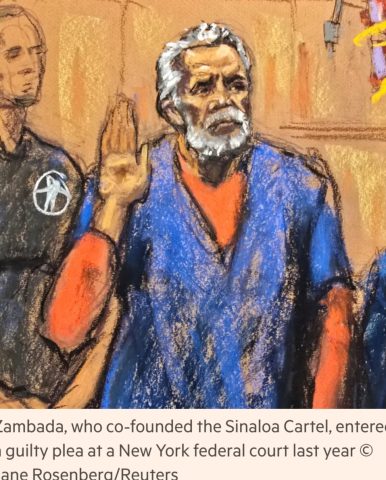
Ismael “El Mayo” Zambada, co-founder of the Sinaloa Cartel in the late 1980s alongside Joaquín “El Chapo” Guzmán, has agreed to surrender $15 billion in illicit proceeds generated over 30 years of operations.
Long considered an almost mythical figure who shunned the public spotlight, the 76-year-old was the ultimate cartel strategist.
He controlled a vast web of corruption, paying off political and military figures to ensure the seamless trafficking of cocaine, heroin, and other dangerous narcotics into the U.S. Market.
Ismael “El Mayo” Zambada, who co-founded the Sinaloa Cartel with Joaquín “El Chapo” Guzmán in the late 1980s, has agreed to surrender up to $15 billion—a record sum calibrated against the criminal enterprise’s illicit revenues over more than three decades.
An almost mythical figure in Mexico who consistently shunned the public spotlight, the 76-year-old Zambada was the cartel’s supreme strategist. He masterminded deep-rooted systemic corruption, routinely bribing key politicians and high-ranking military commanders to ensure the unimpeded transit of multi-ton shipments of cocaine, heroin, and other narcotics directly into the United States.
Last year, he pleaded guilty to operating a continuing criminal enterprise and a racketeering conspiracy charge under a plea agreement negotiated with U.S. authorities.
For decades, he stood as “one of the most — if not the most — prolific and powerful narcotraffickers in the world”, Brooklyn federal prosecutors stated in a court filing leading up to his sentencing. Under Zambada’s strategic command, prosecutors noted, the cartel distributed at least 1.5 million kilograms of cocaine and aggressively diversified into trafficking heroin and fentanyl.
“It would be difficult to overstate the magnitude of the defendant’s crimes and scale of the corruption, violence, and other harm he spread throughout Mexico, the United States, and the world.” nbsp;Prosecutors stated that Zambada’s heavily armed personnel executed “gruesome assassinations and kidnappings” while his syndicate pioneered “novel distribution techniques”, leveraging sophisticated networks of cross-border trains and subterranean tunnels to funnel narcotics into the United States.
His dramatic 2024 abduction and forced removal to American soil—orchestrated by Joaquín Guzmán López, the son of Zambada’s former partner—ignited a brutal intra-cartel civil war across Sinaloa that has claimed thousands of lives.
While the multi-billion-dollar penalty represents the maximum legal threshold prosecutors could pursue against his empire, the U.S. is highly unlikely to recover the full $15 billion. The kingpin’s defense attorney, Frank Perez, noted to the Financial Times that the forfeiture order was “the largest I have ever heard of”
“In a case like this, of course there’s a massive number, but until they find the assets it is only a number,” Stefan Cassella, a former federal asset forfeiture specialist, explained to the FT. Any successfully recovered funds are legally slated for victim restitution and to help subsidize domestic law enforcement initiatives.
The multi-billion-dollar figure ranks among the largest in U.S. criminal history, though it is fundamentally dwarfed by the staggering $171 billion forfeiture order handed to disgraced financier Bernard Madoff.
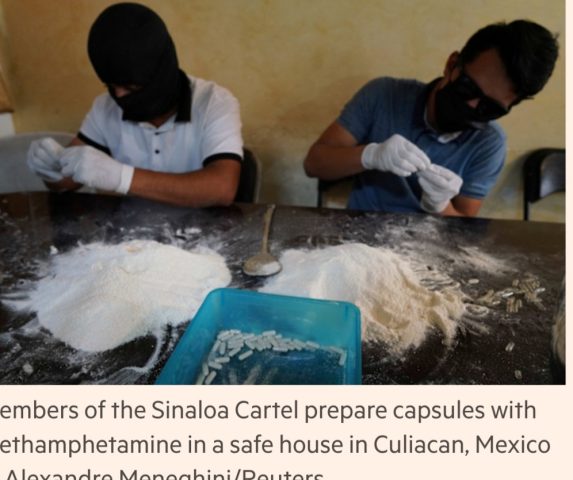
Yet, the scale of the broader illicit empire remains vast. According to conservative estimates from the UN Office on Drugs and Crime, Mexican drug trafficking groups generate in excess of $12 billion annually solely from the sale of heroin, methamphetamines, and cocaine.
Raised in impoverished farming communities nestled within the rugged hills of Sinaloa, Zambada belongs to a rapidly shrinking vanguard of old-time drug cartel bosses. He entered the illicit trade as a young man in the late 1960s, cultivating marijuana before systematically scaling the ranks to become an elite domestic and international kingpin.
His decades of evasion finally caught up with him in American courts, where he has been indicted 16 times across the United States since 2009.
Ray Donovan, the former head of operations at the U.S. Drug Enforcement Administration who also spearheaded the international manhunt to capture Guzmán, noted that Zambada was consistently the more strategic mastermind among the Sinaloa cartel’s dual leadership.
“Chapo [was] more muscle, while Mayo was more brains,” Donovan observed.
The landscape of global drug trafficking has changed dramatically since Zambada’s early days in the mountains, with contemporary syndicates heavily favoring highly lucrative synthetic drugs and dominating the global supply chains of precursor chemicals sourced from China and India.
Chief among these threats is the synthetic opioid fentanyl, which has tragically killed hundreds of thousands of Americans and emerged as a leading cause of death for the nation’s youth.
President Donald Trump’s formal designation of several Mexican cartels as terrorist organizations has significantly broadened Washington’s legal toolkit, empowering the U.S. to dismantle these syndicates and aggressively target the complicit politicians who protect them.
This escalation has prompted Mexican security analysts to note that both Zambada and Guzmán’s sons, notoriously known as the “Chapitos”, possess highly damaging leverage and could potentially hand over incriminating intelligence on sitting government officials.
While Zambada’s defense team clarified that he “did not provide substantial assistance”, they emphasized that the aging kingpin “has sought to be co-operative and accommodating throughout this process to the utmost of his ability.” His attorneys systematically contrasted his demeanor with that of his former partner, Guzmán.
By entering a guilty plea, filing zero pre-trial motions, and intentionally avoiding “one of the most complex federal trials in history”, Zambada was framed as a far more pragmatic and compliant defendant.
In a pre-sentencing court memorandum, the defense noted that Zambada fully “accepts” that his guilty plea mandates a life sentence behind bars. Pointing out that the 76-year-old leader “contends with a complex of age-related health issues”, they requested his placement in a specialized federal facility equipped with comprehensive medical infrastructure.
Furthermore, they strongly urged the court not to relegate him to “the same draconian Supermax prison” housing Guzmán, arguing that Zambada has conducted himself in “the way our system wants to encourage defendants to behave” since his arrival on American soil in 2024.
During that exact period of custody, the fallout back home has been cataclysmic. According to the local newspaper Noroeste, a staggering surge in violence has left more than 3,552 people dead and 4,153 missing across the state of Sinaloa.
Though the U.S. government maintains it did not “induce or condone” Zambada’s initial cross-border abduction by the younger Guzmán, Mexico City continues to aggressively investigate whether Washington misled them regarding its intelligence role.
Adding to the diplomatic friction, Mexican authorities recently conceded that the very pilot who flew Zambada into Texas was inadvertently surrendered to U.S. law enforcement—a critical administrative oversight embedded within a routine prison transfer intended to project cooperation with the Trump administration.