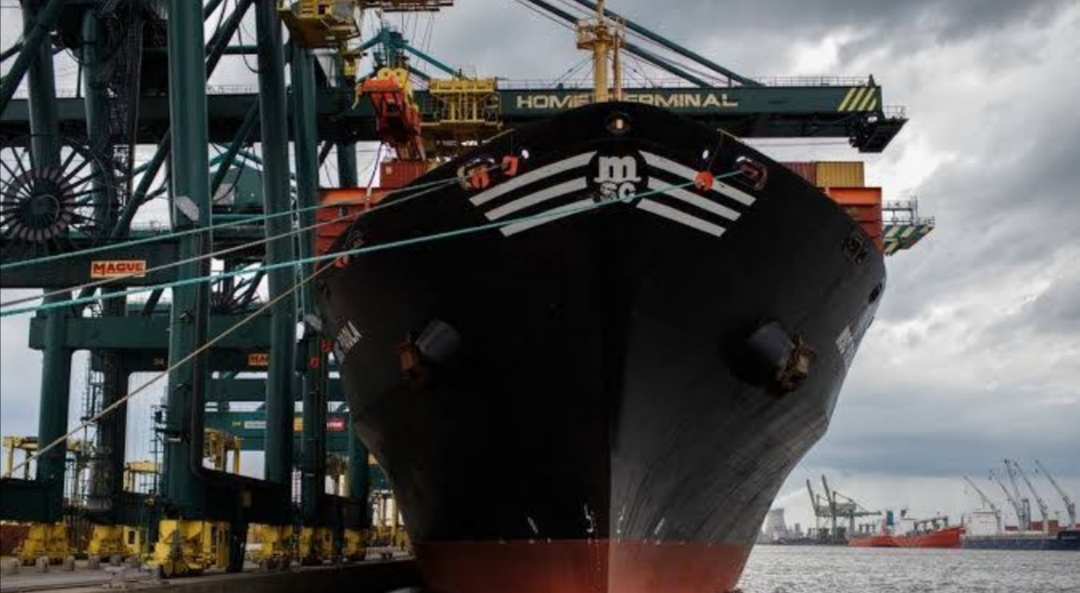
Bypassing the Hormuz chokepoint, the world’s largest container carriers has unveiled a high-speed link between Europe and the Middle East. This innovative route swaps the blocked strait for a cross-Saudi trucking network and regional feeder vessels, effectively redrawing the map for global trade.
Geopolitical volatility in the Red Sea and the Strait of Hormuz is forcing a massive maritime pivot. With traditional routes blocked, Africa has become the essential corridor for global trade, according to the latest logistics and maritime data.
As the maritime blockade persists, Arab News reports a surge in overland trade. Shipowners are bypassing traditional sea lanes in favor of land-based corridors, utilizing trans-regional trucking to move critical food supplies and industrial goods to Gulf markets cut off by the crisis.
The Port of Jeddah has emerged as a vital regional gateway, serving as a primary hub for maritime giants like MSC, CMA CGM, Maersk, and Cosco. With sea access restricted for the past two months, cargo arriving via the Suez Canal is now being offloaded and dispatched across a trans-desert highway. This rapid trucking network ensures that critical deliveries reach Sharjah, Bahrain, and Kuwait, bypassing the maritime blockade.
“The port of Jeddah is not at all sized to handle such import volumes and a port congestion situation is emerging,”
Logistics expert Arthur Barillas de Thé (Ovrsea) highlights a growing crisis at the Port of Jeddah. Kpler data confirms that port congestion is intensifying, with average vessel wait times spiking from 17 to 36 hours in just one week. With 20 ships currently tied up in the harbor, carriers are shifting their strategy. The new industry standard involves offloading at high-capacity hubs outside the Hormuz chokepoint—specifically Sohar, Khorfakkan, and Fujairah—to leverage robust land-bridge networks across the UAE and Oman.
The map of Middle Eastern trade is shifting: Jordan’s Aqaba now serves as the primary staging ground for shipments to southern Iraq, while a robust Turkish land corridor has emerged as the essential entry point for the north. These inland routes are successfully bypassing traditional sea lanes to keep Iraqi markets supplied.
Why are major carriers abandoning the Suez Canal on key international routes?
The roots of today’s shipping crisis extend far beyond the recent escalation in Iran. As noted by CyclOpe, the Red Sea has been a ‘no-go zone’ since late 2023, triggered by the first Houthi-led strikes on container ships.
However, this isn’t just a temporary detour—it’s a fundamental shift in global trade. Kpler’s Ronan Boudet reports that carriers have now fully embraced a systematic bypass of the Suez Canal. By rounding the Cape of Good Hope, ships are taking the long way around Africa to ensure cargo safety, fundamentally redrawing the world’s most critical Asia-to-Europe trade lanes.
“With the current situation in the Gulf, we have put several more coins in the machine, it’s not going to get better anytime soon,” Edouard Louis-Dreyfus, chairman of French shipping giant Louis Dreyfus Armateurs, said.
“Today, 70 percent of the freight traffic that went through the Red Sea in 2023 is being rerouted via the Cape of Good Hope,” added Yves Guillo, a supply chain expert at Efeso, a management consultancy in Paris.
According to the IMF’s PortWatch platform, global shipping patterns have undergone a historic reversal. Commercial traffic rounding the Cape of Good Hope has more than tripled over the last three years, while transits through the Bab Al-Mandeb Strait have plummeted by over 50%.
Similarly, recent data highlights this stark divergence: between March and April 2026, daily traffic around the Cape surged to an average of 20 vessels, up from just six during the same period in 2023. Conversely, the Red Sea corridor has effectively stalled, with daily transits through Bab Al-Mandeb dropping from 18 to a mere five.
What are the consequences?
1) Skyrocketing Operational CostsThe pivot away from the Suez Canal has added an average of two weeks to Asia-Europe transit times. This detour is an expensive necessity; according to industry expert Guillo, the longer route requires 30% to 50% more fuel and a 20% increase in fleet size just to maintain current service frequencies.
2) Surging Freight RatesShipping costs are reflecting these new realities. The Drewry Freight Index reports that the average price to transport a 40-foot container spiked by 14% this April compared to last year. While global rates are up, the impact is felt unevenly across the map.
3) Winners and Losers: Tanger Med vs. SuezThis rerouting has created new maritime winners. Africa’s Tanger Med Port reported a record-breaking 2025, handling 11 million containers—an 8.4% increase. However, the shift has been devastating for Egypt. As Suez Canal traffic withered, toll revenues collapsed. According to CyclOpe, Egypt lost $7 billion in 2024 alone, marking a staggering 60% decline in one of its most critical income streams.