
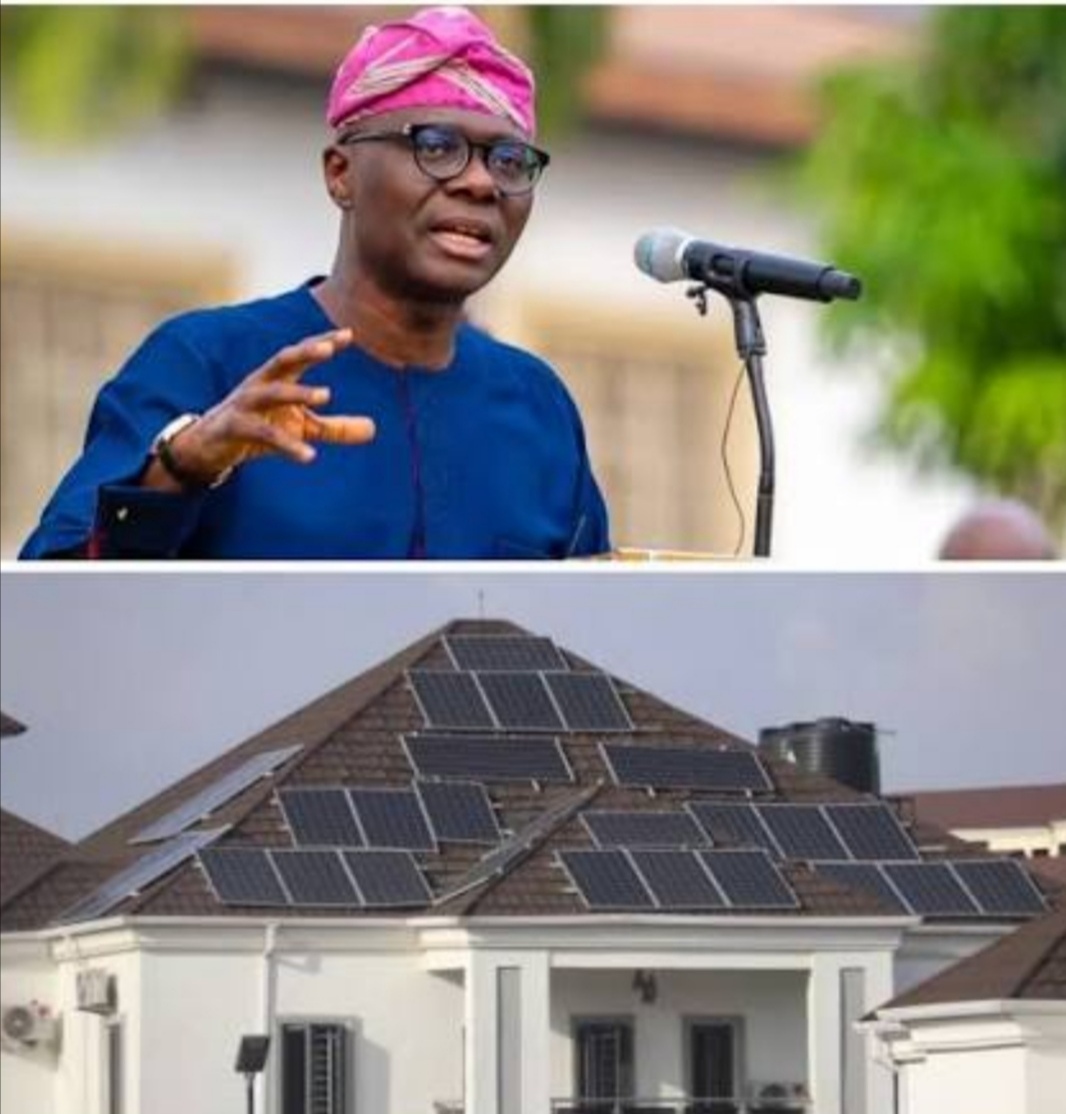
Residents of several Lagos State social housing estates have appealed to Governor Babajide Sanwo-Olu for urgent intervention. They described the new solar installation fees as a heavy burden that, when combined with existing statutory payments, has created a discouraging and painful financial strain.
A viral video recently surfaced showing Lagos State Ministry of Housing officials confronting a resident over a solar panel installation. In response to the backlash, the State Government clarified that permit requirements and administrative fees for solar power systems apply exclusively to residents of government-owned social housing estates. This policy is intended to regulate structural alterations in shared spaces and does not extend to private homeowners across the state.
On Tuesday, April 21, footage went viral showing ministry officials confronting a resident for adopting solar power as a solution to Nigeria’s unreliable grid.
However, this move has drawn sharp backlash, as critics argue that taxing green energy discouraged the very innovation needed to solve the nation’s power crisis. Rather than incentivizing clean energy, these fees are seen as a barrier for households simply trying to keep the lights on.
Wale Ajetunmobi, Senior Special Assistant to the Governor on Media, issued a statement on Wednesday, April 22, clarifying that the resident in the viral video had misconstrued the state’s housing policy regarding solar permits;
“This development is true, but the man who made the video seems to be misinformed about the Lagos State Government’s guidelines for installing solar energy systems in social housing estates.
“He is likely to be a tenant in one of these social housing estates owned by the Lagos State Government. Otherwise, he wouldn’t have raised concerns about something that was clearly outlined in the indemnity document he signed before the Government handed over the apartment to him after purchase,” he said.
He dismissed claims of a widespread “solar tax,” stressing that the charges are restricted to specific state-owned housing;
“Only residents living in the government-owned social housing estates are charged administrative fees for alterations, such as the installation of a solar power system, before any additional development can be permitted,” he said.
The administration maintains that because it is responsible for the upkeep of these social housing estates, all solar projects must be regulated.
These installations are considered “structural alterations” that can compromise shared spaces and the safety of the original building design if not properly overseen;
“Any alteration must be run through the Physical Planning and Survey departments of the Ministry of Housing for approval, material compliance and post-inspection checks.“
According to the statement, the intervention was a standard enforcement action by the Ministry’s Monitoring and Compliance Unit following an unauthorized installation.
The government underscored the necessity of these permits by pointing to a history of costly liabilities, including structural damage and fire hazards caused by unverified alterations to state-owned buildings.
“The simple rule for any estate occupant is to contact the State Government (facility manager) for approval for any external alteration,” he said, warning that unapproved changes affecting shared property could leave the government liable to other residents.
Under the Lagos State Urban and Regional Planning and Development Law, any structural modification requires formal approval. Officials maintain that this mandate extends to solar installations, as they can significantly impact the structural integrity and architectural design of residential buildings.
However, seems the level of worrisome and grievances, Sooth News was on Saturday April 25 visited two of these social houses (Government built but sold out) and in an exclusive interview with us, residents from two prominent government estates, dating back to the Marwa and Tinubu eras, have spoke out in a very remorseful, worrisome, pale and disarray situations on the new solar fee policies.
Fearing potential victimization from the state’s monitoring teams, the residents spoke on the condition of anonymity for both themselves and their estates. Despite their fears, they were vocal in their appeal to Governor Babajide Sanwo-Olu, arguing that the “technicalities the some civil servants working in those ministry are coming up with is not true and one can describe it as inhumane considering the current economic realities.
“How do they want us to survive?” one homeowner asked, highlighting the mounting financial pressure on residents. They pointed to a long list of overheads, including the Annual Land Use Charge (LUC), inconsistent PSP services, and skyrocketing electricity bills. The resident lamented the lack of security and basic maintenance, noting:
“We pay Annual Land Use Charge (LUC), there is currently unregulated PSP charges, which they are not prompt in picking the refuse, very harsh and unhealthy power bills, Lasaco is on our neck for Insuring of our respective flats, monthly estate security bill, etc and consistent taxes. How do we cope? We can’t even fix video camera, we have minor cases of hose broken and theft of particularly electrical cable, especially for those houses whose owners have traveled. Even the Presidency has reportedly shifted to solar.”
“We are appealing to His Excellency, the Governor of Lagos, to intervene, ease this tension, and allow us to install solar without intimidation or extra fees. Kai… Let’s have an itch-free, financial-burden-free estate,” the residents pleaded.
When asked if monitoring is necessary to prevent the defacing of structures, the residents agreed on the need for oversight but called for compassion. They noted: “Yes, there should be monitoring, and any violation to the structure should be liable to a fee. Don’t forget, they have facility managers in all the estates who report to them. Let’s have succour,” the residents appealed.
Efforts to reach the Community Development Association (CDA) management for comment were unsuccessful at the time of this report. Similarly, calls to the Lagos State Ministry of Housing was unsuccessful. . As we await an official government intervention or further clarification, we urge all residents to remain calm and law-abiding.