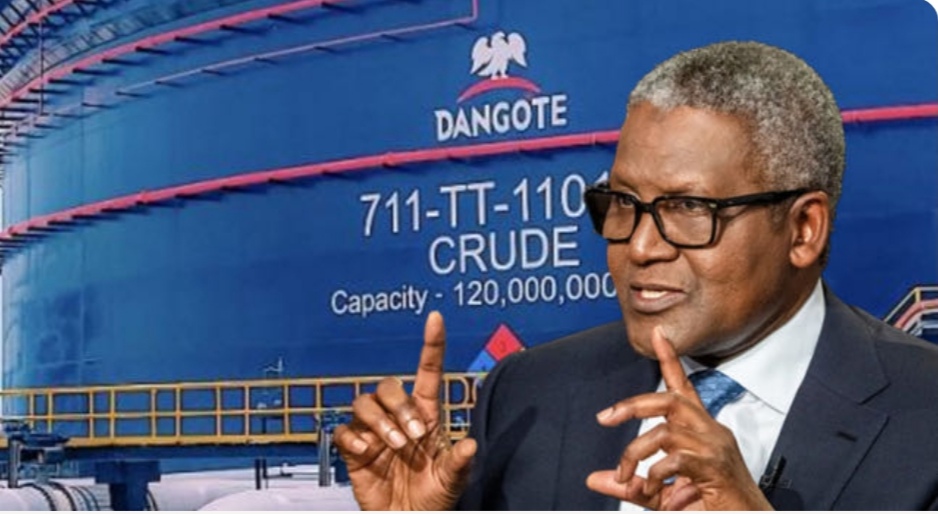
The President of the Dangote Group, Alhaji Aliko Dangote, on Wednesday said that the group turned down requests by the Nigerian National Petroleum Company (NNPC) Limited to increase its stake in the Dangote Petroleum Refinery.
Speaking with Norwegian Sovereign Wealth Fund CEO Nicolai Tangen via Channels Television, Dangote disclosed that NNPC’s buyout proposal was declined. The rejection marks a strategic move to prioritize local investors ahead of the refinery’s highly anticipated IPO, ensuring everyday Nigerians gain equity in the mega-plant.
NNPC acquired a 7.25% share in the refinery for $1 billion in 2021. This initial deal came with a strategic option to buy out the noremaining 12.75% stake before the June 2024 deadline.
Dangote confirmed to Tangen that NNPC’s push for a larger slice of the refinery was rejected. Addressing macroeconomic threats, the billionaire industrialist cited policy flip-flops and civil unrest as the main risks jeopardizing the plant’s future.
“The other biggest risk is government inconsistencies in policies, and we are naddressing that one because if you look at our refinery, the national oil company already owns 7.25 per cent, and they are trying to buy more. We are the ones that said no; we want to now spread it and have everybody be part of it.”
Aliko Dangote shattered a popular public narrative in 2024 when he disclosed that NNPC’s stake in his mega-refinery had dropped to 7.2%. While many Nigerians believed the state oil firm retained a 20% share, the equity was capped under former Group CEO Mele Kyari.
“The agreement was actually 20 per cent, which we had with NNPC, and they did not pay the balance of the money up until last year; then we gave them another extension up until June (2024), and they said that they would remain where they had already paid, which is 7.2 per cent. So NNPC owns only 7.2 per cent, not 20 per cent,”
In a move that caught many Nigerians off guard, Dangote broke his silence in 2024
Meanwhile, Dangote acknowledged that building the world-class facility required massive liquidity, which was secured through extensive credit facilities from several major financial institutions and local banks.
According to him, the initial plan was to fund most of the construction work :
“from our internally generated funds”, but because of naira devaluation, the group “had to rely on Afreximbank, Africa Finance Corporation, Zenith Bank, Access Bank, UBA and a couple of the local banks, but of course we also have a very good relationship with the Standard Bank of South Africa and, at the beginning, Standard Chartered Bank of the UK”.
The President of the Dangote Group added that fortune favored the enterprise, noting that the plant’s completion yielded results that far surpassed their internal expectations
“turned out to be much more than our own expectations”.
Speaking about crude supply, Dangote said, “We source about 56 per cent from Nigeria and some from Angola. We buy quite a bit from Angola, we buy from Libya, and we buy from the US. At one point, we were doing about seven to eight cargoes of WTI from the US. But we’re getting more of Nigeria’s crude now. We have to now buy 21 cargoes every month. That’s how big we are. And we’re more than doubling the refinery. You know, in the next 30 months, we will be at 1.4 million barrels per day, which is huge.”
Billionaire industrialist Aliko Dangote drew a battle line, naming the powerful “Mafia” cartels that attempted to derail the mega-refinery to protect their financial empires.
“The mafia consists of those who weaponised Nigeria’s $10 billion annual fuel subsidy,” Dangote revealed.
“Shippers and traders made massive profits swapping crude for imported fuel, while a small ring of local players hoarded subsidised allocations for billions in profit. They fought to stop us from operationalising because they knew we would disrupt their network. Ultimately, we displaced them completely.”
To anchor a landmark $100 billion revenue target by 2030, Dangote confirmed plans to sell off corporate stakes and reinvest $45 billion across the group’s business portfolio.
“We are coming up with selling part of the business, getting more investors into the business, and also making sure that we continue to grow the business. Cement production is going to 100 million tonnes. In cement, we don’t even need much money; we are getting financing, and the cash generation is very liquid.
“So, we’ll be able to actually fund this $45bn, which will eventually take us to $100bn of revenue, because our target is to get to $100bn by 2030, with a market valuation of maybe more than $250bn, because as we speak today, last year, our EBITDA was $3bn, but the target by 2030 is to be 10 times that amount, to be at over $30bn of EBITDA,” he stated.
Liquidating My Global Portfolio: How I Sold My US and UK Properties to Return to Nigeria”
“When I decided to go into the industry, you know what I did? I sold all my properties in the US. I had two houses in the US, big nmansions, and I had a house in the UK. I wanted to really sit in Nigeria and concentrate.
“You know, sometimes when you own a holiday home anywhere, you have to create that time to go and use that property. So, now my life is very simple. Wherever I go, I use hotels; I pay. When I leave, nobody will call me and say I have a burst pipe or something is wrong. So I’m committed to what I do, and I just don’t do things; I always create a vision.
“It’s just like now; we created a vision for 2030. So, I know I have a target to meet. I just don’t do business. All my businesses are targeted,” he said.
Explaining his formula for entering new markets, the billionaire mogul detailed his strategy: “My starting point is asking: What do our people need? What are we importing that we should be manufacturing ourselves? This drives our strategy of backward integration. We create essential products so that when you wake up every morning, using a product from our ecosystem is a natural part of your daily routine.”