
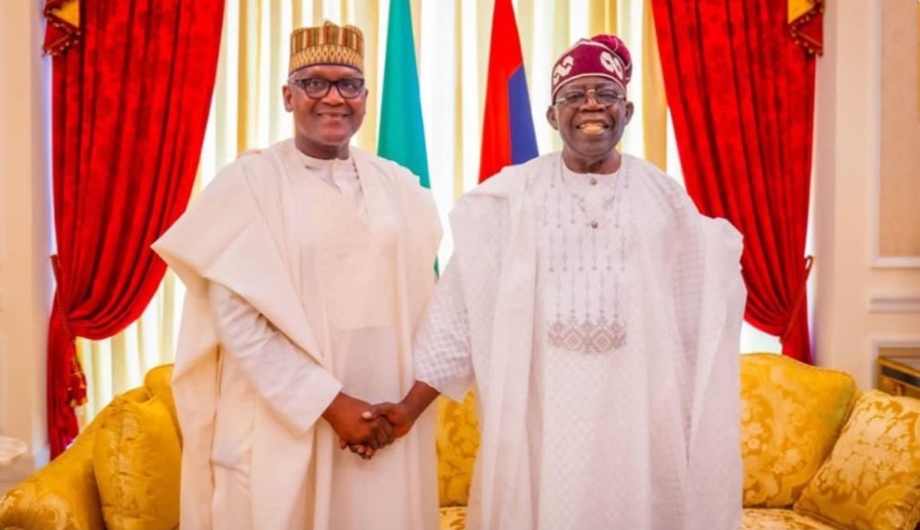
Following a crucial meeting with President Bola Tinubu on Friday December 5, at the Presidential Villa, Abuja, Aliko Dangote made a bold promise to Nigerians: “The era of fuel queues… is gone forever.”
The Dangote Group President guaranteed stable fuel supply for the Christmas period, announcing that his refinery is ready to flood the market. The company has informed the NMDPRA that it can now supply a massive 50 million litres of PMS daily, ensuring consumption needs are well covered and scarcity is history.
“Historically, Nigeria has battled fuel queues since 1972. For the first time, we are eliminating those queues, not through imports but by producing locally,” he said.
“Even when we were servicing the refinery, there were no queues. I can assure you that queues are now history.”
Dangote also highlighted that by February 2026, the Refinery aims for regional dominance. Dangote confirmed that neighbouring West African nations can expect supply, as the facility is set to exceed Nigeria’s consumption needs by an impressive 15 to 20 million litres daily, ensuring stability across the sub-region.
“So, we must export. Even our neighbours won’t experience queues because they can buy from us,” he said.
Dangote also stated that beyond fuel, the refinery is set to revolutionize domestic manufacturing. Dangote explained that local producers, especially in the plastics industry, who previously spent approximately $400 million annually on imported feedstock, will now receive full local supply, drastically reducing foreign exchange pressure.
However, looking ahead, Dangote unveiled an ambitious expansion drive: the goal is to raise the refinery’s capacity to 1.4 million barrels per day by 2028. This aggressive expansion is designed to surpass India’s Reliance refinery (currently 1.25 million bpd) and claim the title of the world’s single largest refinery complex.
“We have already signed the necessary agreements. Construction piling begins before the end of January, and we will deliver on schedule,” he assured.
He also disclosed plans to scale up urea output to 12 million tonnes annually, positioning Nigeria as the world’s largest producer ahead of Russia and Qatar. “Our goal is to use our fertiliser company to supply the entire African continent,” he said.
President of the Dangote Group, Alhaji Aliko Dangote, on Friday declared that the era of fuel queues in Nigeria “is gone forever,” assuring that petrol supply will remain stable throughout the Christmas season and beyond.
Speaking with journalists after a closed door meeting with President Bola Tinubu at the State House, Abuja, Dangote said the company has already notified the Nigerian Midstream and Downstream Petroleum Regulatory Authority (NMDPRA) of its ability to supply 50 million litres of Premium Motor Spirit (PMS) daily, well above the country’s consumption needs.
“Historically, Nigeria has battled fuel queues since 1972. For the first time, we are eliminating those queues, not through imports but by producing locally,” he said.
“Even when we were servicing the refinery, there were no queues. I can assure you that queues are now history.”
Dangote added that neighbouring countries will also benefit, noting that by February, the refinery will be able to supply 15 to 20 million litres more than Nigeria consumes.
“So, we must export. Even our neighbours won’t experience queues because they can buy from us,” he said.
He explained that domestic manufacturers, particularly in the plastics sector, which previously spent up to $400 million annually on imports, will now receive full local supply of their feedstock.
On the refinery’s long-term plans, Dangote unveiled an ambitious expansion drive to raise capacity to 1.4 million barrels per day by 2028, overtaking India’s Reliance refinery, currently the world’s largest at 1.25 million barrels per day.
“We have already signed the necessary agreements. Construction piling begins before the end of January, and we will deliver on schedule,” he assured.
He also disclosed plans to scale up urea output to 12 million tonnes annually, positioning Nigeria as the world’s largest producer ahead of Russia and Qatar. “Our goal is to use our fertiliser company to supply the entire African continent,” he said.
Responding to inquiries about the recent fall in local petrol and diesel prices, Dangote attributed the positive shift primarily to increased market competition and a significant crackdown on fuel smuggling operations.
“Prices are going down because we must compete with imports. Luckily, smuggling has dropped significantly, though not completely,” he said.
Dangote emphasized the refinery’s long-term vision, stating its operations are not guided by immediate profits but a commitment to national stability and industrialization.
“We’re not here to recover $20 billion overnight; this is a long-term investment. The legacy I want to leave is that whatever Nigerians need, fuel, fertiliser, power, we will be part of delivering it.”
Dangote also turned his attention to systemic hurdles within Nigeria’s solid minerals sector. He specifically highlighted limited port capacity as a critical structural challenge hindering the industry’s growth and export potential.
“Apapa is full. Tin Can is full. Lekki is mainly for containers. You cannot export coal or copper if you have nowhere to ship from,” he noted.
In a strategic move to curb the problem, we are developing a new facility: the largest deep-sea port in the region. Located at Olokola, this pivotal infrastructure project is expected to be operational in two to two and a half years, promising enhanced efficiency and capacity for the entire West African market.
He expressed strong support for the Tinubu administration’s naira-for-crude initiative, describing it as a patriotic policy to strengthen the local economy.
The Dangote Group President confirmed initial opposition from international oil companies, driven by their pursuit of favorable offshore premiums
“It’s a teething problem, but it will be resolved, either through legislation or administrative action,” he said.
On competition, he dismissed concerns that the refinery may struggle against global players.
“What we want is to make Nigeria the refining hub of Africa. All African countries import fuel. We want what we consume to be produced here,” he said.
Dangote also backed the administration’s Nigeria-first industrial policy, warning that persistent import dependence “is simply importing poverty and exporting jobs.”
He urged wealthy Nigerians to invest in industry rather than luxury consumption. “If you have money for a private jet, invest in industries and create jobs,” he said.
According to him, industrial investment, not extravagant personal acquisitions, remains the surest path to sustainable economic growth, adding that domestic investors must take the lead if Nigeria is to achieve long-term prosperity.
He acknowledged the economic risks that undermined industrialisation in the past, policy inconsistencies, smuggling, and collapsing factories, but expressed optimism that Nigeria now has a viable path to sustainable industrial growth.
“Domestic investors must lead the way. Once they do, foreign investors will follow. Nobody advertises a good restaurant; when the food is good, word spreads,” he said.
Regarding his meeting with President Tinubu, Dangote described it as a routine consultation. “It was just a normal courtesy visit, an opportunity to discuss the economy and the business environment. It was a very fruitful meeting,” he said.
Addressing concerns that the refinery might struggle against global players, he asserted the refinery’s ambitious goal:
“What we want is to make Nigeria the refining hub of Africa. All African countries import fuel. We want what we consume to be produced here.”
Dangote also endorsed the administration’s Nigeria-first industrial policy, emphasizing that persistent import dependence harms the national economy:
“Import dependence is simply importing poverty and exporting jobs.”
He further encouraged affluent Nigerians to invest domestically in job-creating industries rather than luxury consumption:
“If you have money for a private jet, invest in industries and create jobs.”
According to him, industrial investment—not extravagant personal acquisitions—remains the surest path to sustainable economic growth. He stressed that domestic investors must spearhead this initiative for Nigeria to achieve long-term prosperity.
He acknowledged past economic risks that undermined industrialisation—policy inconsistencies, smuggling, and factory collapses—but expressed optimism about the current viable path to sustainable industrial growth:
“Domestic investors must lead the way. Once they do, foreign investors will follow.
Nobody advertises a good restaurant; when the food is good, word spreads.”
Regarding his recent meeting with President Tinubu, Dangote described it as a routine consultation:
“It was just a normal courtesy visit, an opportunity to discuss the economy and the business environment. It was a very fruitful meeting.”